
Blog
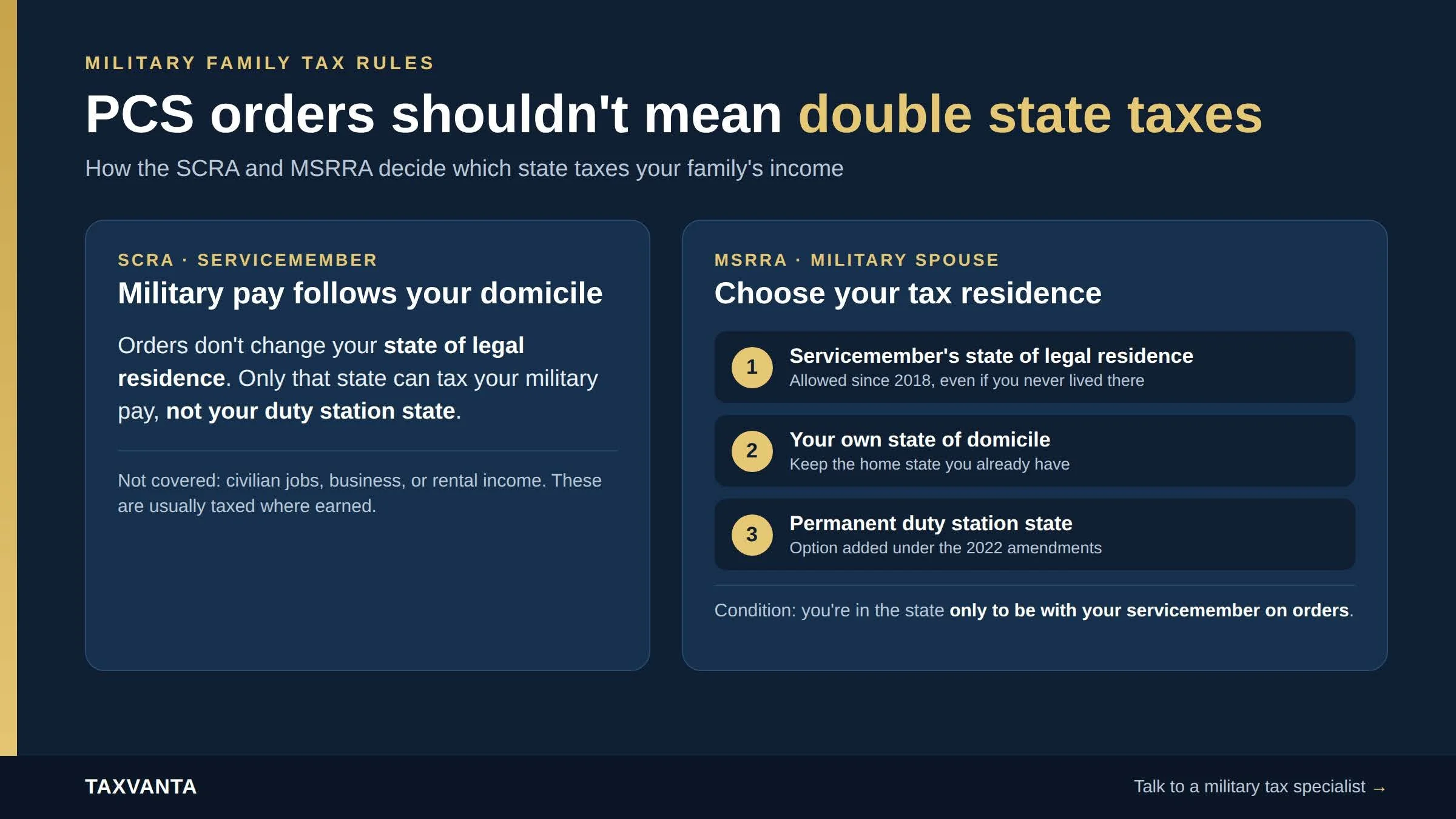
State of Legal Residence for Military Families: SCRA & MSRRA Tax Rules Explained
The Servicemembers Civil Relief Act (SCRA) is a federal law that, among other protections, says a servicemember does not lose or gain a state of legal residence for tax purposes just because military orders move them to another state. Their military pay is taxable only by their state of legal residence. The Military Spouses Residency Relief Act (MSRRA) is a 2009 amendment to the SCRA that extends similar protection to military spouses: a spouse who moves to a state only to be with a servicemember on orders can keep their own state of legal residence for tax purposes, and the host state can't tax the spouse's wages earned there.
Put simply: a PCS move doesn't have to change which state you pay income tax to. Here's how the rules work, how they've changed since 2009, and the mistakes that most often lead to double state taxes.

How to Choose a Tax Preparer for Your Small Business: Questions to Ask Before You Hire
Anyone can legally prepare a tax return for pay as long as they have a PTIN — a preparer tax identification number that takes about ten minutes to get online.

Is VA Disability Compensation Taxable? A Veteran's Guide to Tax-Free Benefits
Between VA waivers, CRDP, CRSC, and retroactive rating decisions, it's easy for military retirement income to get taxed incorrectly — usually not because the rules are unclear, but because the paperwork doesn't catch up to a rating change right away.

OBBBA Small Business Tax Changes for 2026: What Changed and How to Plan Now
The One Big Beautiful Bill Act, commonly shortened to OBBBA, is the 2025 federal tax law that extended and expanded major provisions of the 2017 Tax Cuts and Jobs Act. For small business owners, the practical effect is a handful of specific, dollar-and-cents changes to depreciation, the pass-through deduction, R&D cost recovery, and interest expense limits — several of which the IRS has already built into its 2026 inflation-adjusted figures.

5 Tax Breaks Veterans Miss Because Their Tax Preparer Doesn't Ask About Their DD-214
Most tax preparers are generalists, and there's nothing wrong with that — most returns don't need a specialist. Military retirement pay isn't like most returns, though. It comes with its own set of rules, forms, and elections that simply don't come up for the average client, which means they don't come up for the average preparer either. If nobody asks, nobody catches them.
Here are five that we see missed most often.

Your First Tax Return After Retiring From the Military: What's Different
Somewhere between out-processing paperwork, a final PCS, and figuring out what civilian job comes next, taxes are probably not at the top of your mind the year you retire. They should be closer to it than usual, though — because the year you transition out of active duty is one of the most complicated tax years you'll ever file, and it only happens once.
Here's what actually changes.

Is Military Retirement Pay Taxable in Your State?
If you're retiring from the military — or you already have — you've probably noticed that tax advice aimed at "retirees" in general doesn't quite fit your situation. Regular retirement guides talk about pensions and 401(k)s. They rarely mention CRDP, CRSC, or the fact that your retired pay is taxed completely differently depending on which state you happen to live in.
That last part is the one that catches people off guard. Your federal tax bill on military retirement pay is the same no matter where you live. Your state tax bill can range from zero to several thousand dollars a year, for the exact same pension, just because of a zip code.