
Last updated: November 23, 2026 | By Scott Vance, Enrolled Agent
Quick Answer
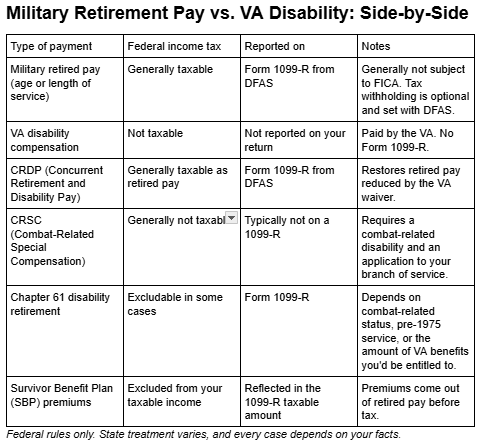
Yes, in most cases. Military retirement pay based on age or length of service is taxable income on your federal return. VA disability compensation is not taxable and is not reported at all. The two are taxed differently even when they arrive in the same month, so it matters which dollars are which.
If you're asking is military retirement pay taxable because a Form 1099-R just showed up, you are in the right place. Military retired pay works like a civilian pension for tax purposes: the Air Force benefits library states that retirement pay based on age or length of service "is taxable and must be included as income for Federal income taxes." VA disability compensation sits on the other side of the line, since veterans' disability benefits are excluded from federal taxable income (see the same page and IRS Publication 525).
Many retirees receive both, and a few programs blur the line. This guide explains how each payment is taxed, how CRDP and CRSC fit in, and how to read your Form 1099-R.
How Is Military Retirement Pay Taxed?
Retired pay is taxed at your ordinary income tax rates, so it stacks on top of other income such as a civilian paycheck, a spouse's wages, or business income. That is why a retiree who starts a second career often sees a bigger tax bill than expected in the first year. This blog discusses retirement income and state taxability.
Because retired pay is not subject to Social Security and Medicare tax, you won't see FICA taken out. Income tax withholding is not automatic in the way many people assume, so review your withholding with DFAS, or make estimated tax payments, to avoid an April surprise.
Example: a retiree starting a second career
A retired Army sergeant first class takes a civilian job in North Carolina with a salary and also receives retired pay. The salary has withholding from the new employer. The retired pay might have none. At filing time, both are added together, and the unwithheld tax on the retired pay comes due. A short planning review in the first year of retirement can prevent this.
Is VA Disability Pay Taxable?
No. Disability compensation and pension payments for disabilities, paid to veterans or their families, are excluded from federal taxable income. You do not list them as income, and the VA does not issue a 1099-R for them. Read this recent blog post about VA disability compensation.
There is one place the two programs meet. By law, retirees generally must waive some of their retired pay dollar for dollar by the amount of VA disability compensation they receive. DFAS explains the VA waiver and notes that it does not change the amount of compensation the VA pays you. The practical result is that more of your total income comes through the tax-free VA payment and less through taxable retired pay.
CRDP vs. CRSC: How Concurrent Receipt Is Taxed
Concurrent receipt programs let some retirees get back the retired pay the VA waiver would otherwise take away. There are two, and you can receive only one.
CRDP (Concurrent Retirement and Disability Pay) restores retired pay for eligible retirees. It is paid as retired pay, so it is generally taxable and appears on your Form 1099-R.
CRSC (Combat-Related Special Compensation) is for disabilities that are combat-related and requires an application to your branch of service. It is generally treated as tax-free, like VA disability.
Because one is generally taxable and the other generally is not, two retirees with the same gross payment can have different after-tax income. Run the numbers on both before electing.
How Do I Read My Form 1099-R From DFAS?
DFAS sends a Form 1099-R each January for retired pay. Box 1 shows the gross distribution and Box 2a shows the taxable amount. If you waived retired pay for VA compensation, the form should generally reflect the reduced amount. Check that the figures match your January pay statement, and contact DFAS if they don't.
When Part of Your Retirement Pay Can Be Tax-Free
Some disability-related payments can be excluded even though they come through retired pay. The Air Force benefits library lists these situations for military disability retirement: entitlement before September 25, 1975, a combat-related injury, or being entitled to VA disability benefits if you applied. In that last case the exclusion equals the amount you would receive from the VA. Details are in IRS Publication 525 and the Armed Forces' Tax Guide (Publication 3).
Two timing rules are worth knowing. If the VA grants a retroactive rating on a years-of-service retirement, retired pay for that period may be excludable up to the VA benefit amount, and you can claim a refund with an amended return (Form 1040-X). A lump-sum disability severance can be excluded if you are later awarded VA benefits, but non-disability readjustment or severance pay generally stays taxable even with a retroactive rating.
What About State Income Tax?
States set their own rules. Some exempt military retirement pay completely, some exempt part of it, and some tax it like any other income. VA disability is generally not taxed by states. North Carolina currently exempts military retirement pay for qualifying retirees.
Frequently Asked Questions
Is military retirement pay taxable?
Yes, in most cases. Military retired pay based on age or length of service counts as taxable income for federal income tax purposes, the same way a civilian pension does. It is generally not subject to Social Security and Medicare (FICA) tax. DFAS reports it to you and the IRS on Form 1099-R each January. Your state may tax it differently.
Is VA disability compensation taxable?
No. VA disability compensation is generally excluded from federal taxable income, and you don't report it on your return. The VA doesn't send a Form 1099-R for it. This is true whether you also receive military retirement pay or not, although the two payments can interact through the VA waiver or concurrent receipt programs.
What is the tax difference between CRDP and CRSC?
CRDP restores retired pay that the VA waiver would otherwise reduce, and it is generally taxed as retired pay. CRSC compensates for combat-related disabilities and is generally tax-free. You can receive only one of the two. Because the tax results differ, the choice between them can change your take-home pay, so compare both before electing.
Can part of my military retirement pay be tax-free?
Sometimes. If you receive a disability retirement under Chapter 61, or the VA waives part of your retired pay, some or all of that amount may be excluded from income. A retroactive VA rating can also allow a refund through an amended return. The rules depend on your facts, so have a tax professional review your records.
Get Your Retirement Income Tax Picture Reviewed
Retired pay, VA compensation, a second job and a spouse's income all interact on one return. Book a consultation and we'll review your retirement income tax picture together or learn more about our tax planning and tax preparation services.
Written by Scott Vance, Enrolled Agent, Taxvanta. Scott helps military families, veterans and small business owners plan for and file their taxes.
This article is for general information and isn't tax advice for your specific situation. Tax rules change, so confirm details with a qualified tax professional before acting.
Taxvanta, 300 S. Main St, Suite 212, Holly Springs, NC 27540 | (910) 360-8041 | scott@taxvanta.com | www.taxvanta.com