
Last updated: November 12, 2026
Quick Answer: Yes. The One Big Beautiful Bill Act (OBBBA) made the 20% qualified business income (QBI) deduction permanent. Eligible owners of sole proprietorships, partnerships, and S corporations generally deduct up to 20% of QBI, subject to taxable-income, wage, and property limits. For 2026, those limits begin at $201,750 of taxable income for single filers and $403,500 for joint filers.
If you own a pass-through business, the QBI deduction 2026 OBBBA rules are good news and worth a closer look. The One Big Beautiful Bill Act (OBBBA) removed the scheduled expiration of the qualified business income deduction, so the 20% deduction under Section 199A is now a permanent part of the tax code for noncorporate taxpayers (RSM, Texas Society of CPAs). Below is how the deduction works, what changed for 2026, and the planning moves to discuss before year-end.
What is the qualified business income (QBI) deduction?
The QBI deduction lets eligible owners deduct up to 20% of the qualified business income their business earns, plus 20% of qualified REIT dividends and publicly traded partnership income (IRS: Qualified Business Income Deduction). It is claimed on your personal return, so it reduces your income tax but not self-employment tax.
Qualified business income is the net profit from a U.S. trade or business after business deductions. It generally leaves out wages you earn as an employee, reasonable compensation paid to you by your own S corporation, and guaranteed payments from a partnership. Income earned through a C corporation is not eligible.
Is the QBI deduction permanent?
Yes. The deduction was originally set to expire after December 31, 2025. OBBBA removed that sunset, which means pass-through owners can plan around it from 2026 forward. Permanent does not mean frozen: Congress can still change the rules later, and several inflation adjustments now apply, so an annual check-in is still worthwhile.
QBI deduction 2026 OBBBA changes: what is new
OBBBA kept the 20% rate and the basic structure, and it made two changes that start with tax years beginning after December 31, 2025 (IRS Rev. Proc. 2025-32):
A wider phase-in range. The window in which the wage, property, and specified-service limits phase in grew from $50,000 to $75,000 for single filers and from $100,000 to $150,000 for joint filers.
A new $400 minimum deduction. A taxpayer with at least $1,000 of qualified business income from businesses they actively run can claim at least $400. The $400 and $1,000 amounts are adjusted for inflation after 2026.
2026 QBI income thresholds at a glance
Your taxable income decides how much of the deduction the limits can take away. These are the 2026 amounts from Rev. Proc. 2025-32 (see also Current Federal Tax Developments):
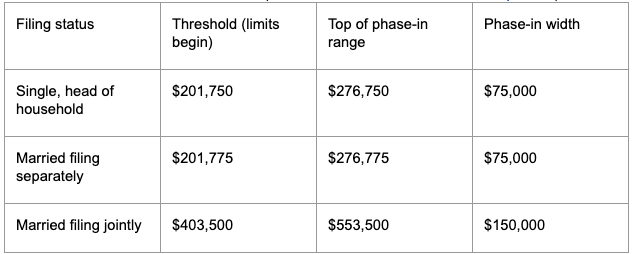
2026 QBI Income Thresholds table
At or below the threshold, the deduction is generally 20% of QBI, capped by 20% of your taxable income after subtracting net capital gain. Above the threshold, the limits below phase in. Above the top of the range, they apply in full.
How do SSTB, W-2 wage, and property limits work?
A specified service trade or business (SSTB) includes fields such as health, law, accounting, consulting, financial services, and athletics, and any business whose main asset is the reputation or skill of its owners or employees. Architects and engineers are not treated as SSTBs (Texas Society of CPAs).
SSTB owners: the deduction phases down across the range and is zero above the top of it.
Other businesses: above the range, the QBI component generally cannot exceed the greater of 50% of the business's W-2 wages, or 25% of W-2 wages plus 2.5% of the unadjusted basis of qualified property, such as equipment and buildings (CPA Practice Advisor).
REIT dividends and publicly traded partnership income: this 20% component is not limited by wages or property (IRS).
Three examples: How the QBI deduction works
These are simplified illustrations for a single filer, not predictions for your return.
Below the threshold. A sole proprietor with a home-repair business has $100,000 of QBI and $150,000 of taxable income before the QBI deduction. Twenty percent of QBI is 20,000,which is below 20% of taxable income (30,000, assuming no net capital gain). The deduction is about $20,000.
SSTB above the range. A consultant (an SSTB) has $300,000 of taxable income, above the $276,750 top of the single range. The deduction is generally zero. Planning to bring income down before December 31 could matter.
Non-SSTB above the range. An S corporation owner has $350,000 of QBI and the company paid $120,000 in W-2 wages. Twenty percent of QBI is $70,000, but the wage limit is 50% of $120,000, or $60,000. The deduction is limited to about $60,000.
Planning moves to discuss before December 31
Know where you sit against the threshold. A few thousand dollars of income can change the result for an SSTB owner near the top of the range.
Review S corporation wages. Reasonable compensation reduces QBI but also creates the W-2 wages that can support the deduction. The balance depends on your numbers. Read this blog post about how being an S-Corp or LLC can affect your tax bill.
Check equipment timing. Qualified property can help the property limit, and purchases interact with expensing choices. Read this blog post about Section 179 and Bonus depreciation.
Track material participation. The new $400 minimum applies to businesses you actively run, so keep records of your involvement.
Keep clean books. Separate QBI by business and keep profit and loss statements current so your preparer can compute the deduction correctly.
For the bigger picture, see our overview of OBBBA small business tax changes. Our tax preparation and tax planning services can run the QBI calculation on your return.
Frequently asked questions
Is the QBI deduction permanent under OBBBA?
Yes. Before OBBBA, the 20% QBI deduction was scheduled to expire after 2025. The law made it permanent for noncorporate taxpayers. Permanent means Congress removed the sunset date, not that the rules can never change, so it is still smart to review your numbers each year with a tax professional.
What is the QBI deduction in simple terms?
The QBI deduction lets owners of sole proprietorships, partnerships, S corporations, and some trusts and estates deduct up to 20% of their qualified business income from taxable income. It is taken on your personal return, not the business return, and wages you earn as an employee do not count as qualified business income.
Who qualifies for the 20% pass-through deduction?
Owners of pass-through businesses generally qualify, including sole proprietors, partners, and S corporation shareholders. C corporations and employees do not. Above the income threshold, a specified service business can lose the deduction, and other businesses can be limited by W-2 wages and business property. Your facts decide, so confirm eligibility before you rely on it.
What is the new $400 minimum QBI deduction?
For tax years beginning after 2025, a taxpayer with at least $1,000 of qualified business income from businesses they actively run, meaning they materially participate, can claim a minimum QBI deduction of $400. The $400 and $1,000 amounts are adjusted for inflation after 2026. Most owners with real profit will calculate more than $400 under the regular formula.
Next step
See how QBI applies to your business
Written by Scott Vance, Enrolled Agent, Taxvanta. Scott helps military families and small business owners plan and prepare their taxes.
This article is for general information and isn't tax advice for your specific situation. Tax rules change, so confirm details with a qualified tax professional before acting.
Taxvanta, 300 S. Main St, Suite 212, Holly Springs, NC 27540 · (910) 360-8041 · scott@taxvanta.com · www.taxvanta.com