
Last updated: November 5, 2026 (publish date: Monday, November 9, 2026)
Quick Answer: Yes, veterans have several tax benefits in 2026. VA disability compensation and GI Bill payments are generally tax-free, combat zone pay can be excluded, and recent veterans can file free with MilTax. Others depend on your state and situation, so review all ten before you file.
Thank you for your service. If you are searching for tax benefits for veterans 2026, you are in the right place. Many veterans leave money on the table, or worse, report income they never needed to report, simply because the rules are scattered across IRS publications, VA pages, and state websites. This Veterans Day, here are ten benefits worth checking, with plain-English notes on who each one helps. Your return depends on your facts, so treat this as a starting checklist, not a promise of savings. If you want a pro to run the numbers, see our tax preparation services.
1. VA disability compensation is generally tax-free
Veterans' benefits paid under laws administered by the VA, including disability compensation, are generally not included in your income, and you do not report them on your federal return (IRS Publication 525; Air Force benefits library). The common mistake runs the other way: veterans who receive both a VA check and a military retirement check sometimes treat both the same. They are not. See benefit 6 below and my prior blog on the topic Is VA disability compensation taxable?
2. GI Bill education payments are generally tax-free
VA education, training, and subsistence payments, including GI Bill housing allowances, are generally tax-free and are not reported as income (IRS Publication 970). One wrinkle: if you also claim an education credit, tax-free VA payments used for tuition can reduce the expenses that qualify for that credit. A preparer can sort out the interaction.
3. Combat zone pay can be excluded from income
Pay earned while serving in a designated combat zone is generally excluded from taxable income for enlisted members, while commissioned officers get a capped exclusion; see IRS Publication 3. This is why a W-2 box 1 figure can look lower than your actual pay. Reserve and National Guard members who deploy are covered too.
4. Combat zone service can extend your filing and payment deadlines
Serving in a combat zone or contingency operation generally gives you extra time to file, pay, and take other tax actions. The extension is generally 180 days after you leave the zone, plus the days that remained to act when you entered it. Keep your orders and dates of service in your records.
5. PCS moving expenses may be deductible for active-duty members
Active-duty members who move because of PCS orders can deduct reasonable, unreimbursed moving costs using Form 3903. That includes a move from your last duty station to home within one year after you leave active duty, unless the Joint Travel Regulations allow more time (Military OneSource). Anything the military already reimbursed cannot be deducted. Civilians cannot deduct moving costs for tax years after 2017, so this is a genuine military-only break.
6. Disability retirement pay may be partly or fully excluded
Military retirement pay based on age or length of service is generally taxable. Disability retirement pay can be excluded in whole or part, for example when you would be entitled to VA disability compensation, and the excluded amount generally matches the VA amount (Air Force benefits library). Check Box 2 on your Form 1099-R against your records and ask us if the taxable amount looks high.
7. MilTax offers free filing help for recent veterans
MilTax is the free tax software and consultation service from Military OneSource. It is free for active-duty members, eligible family members, survivors, and recent veterans for up to 365 days after separation or retirement, with eligibility verified through DEERS. Military OneSource says the software opens in January 2027 (MilTax page). Separated this year? Check out our blog post about the First Civilian Year tax checklist.
8. Disabled veterans may qualify for state property tax relief
Property tax breaks are set by states and counties, so the details vary widely. In North Carolina, for example, a qualifying disabled veteran can exclude the first $45,000 of the home's appraised value from taxation. The veteran needs honorable or under-honorable-conditions service and a service-connected, permanent, and total disability certified as of January 1 before the tax year, and the owner generally cannot combine it with other property tax relief programs (N.C. G.S. 105-277.1C). Applications are accepted through June 1 preceding the tax year. Live elsewhere? Check your state veterans affairs or county assessor site.
9. Military members can suspend the five-year home sale test
Normally you must own and live in a home for two of the last five years to exclude gain on a sale. Members of the Armed Forces on qualifying official extended duty can generally suspend that five-year test period, which helps PCS families who rented out a home they once lived in (IRS Publication 3).
10. Reservists can deduct certain travel costs
If you are in the reserves and travel more than 100 miles from home, overnight, to perform your service, you can generally deduct unreimbursed travel expenses without itemizing (IRS Publication 3). It is reported on Schedule 1 after completing Form 2106. Keep mileage logs, lodging receipts, and orders.
One benefit that is not available right now: the Work Opportunity Tax Credit
Veteran business owners often ask about the Work Opportunity Tax Credit for hiring veterans. The IRS program page says the credit applies to wages for individuals who begin work on or before December 31, 2025, and at the time of our research we found no extension for later hires (IRS WOTC page). Employees hired by the deadline can still generate credit in 2026, see our blog post about Veteran-Owned Business tax credits.
Quick Reference
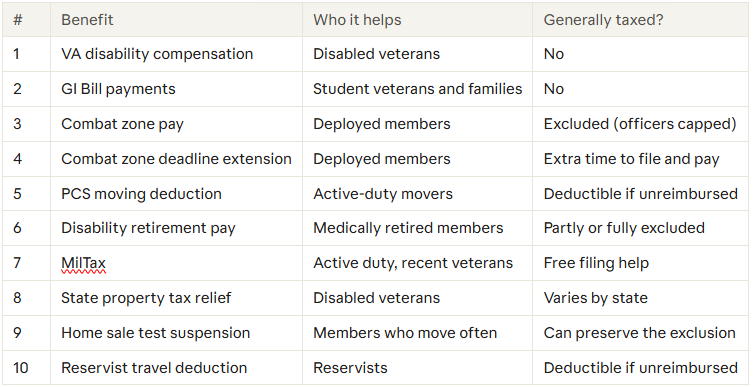
Quick reference taxable table.
Frequently asked questions
Are tax benefits for veterans’ different in 2026?
The core rules are long-settled: VA disability compensation and GI Bill payments are generally tax-free, and military retirement pay generally is not. What changes year to year are inflation-adjusted amounts and credits that Congress renews or lets lapse, such as the Work Opportunity Tax Credit. Always confirm current-year details before you file.
Do veterans get tax deductions just for being veterans?
Not automatically. Most veteran tax advantages are exclusions, meaning certain income never gets taxed, or state-level breaks like property tax relief. Deductions depend on your situation, such as unreimbursed PCS moving costs for active-duty members or travel expenses for reservists. A tax professional can check which ones apply to you.
Is military retirement pay taxable?
Generally yes. Retirement pay based on age or length of service is taxable income at the federal level, although some states exempt all or part of it. Disability retirement pay may be partly or fully excluded when it is tied to VA disability compensation. Your Form 1099-R shows what was reported, so review it carefully.
Can recent veterans file taxes for free?
Recent veterans can use MilTax, the Department of Defense's free tax software and consultation service, for up to 365 days after separation or retirement, with eligibility verified through DEERS. Military OneSource says the software is expected to open in January 2027. Eligibility rules can change, so check the site before relying on it.
Make sure you're claiming every veteran tax benefit
Book a veteran tax consultation with Taxvanta, or learn about our tax planning and preparation services.
Written by Scott Vance, Enrolled Agent, Taxvanta. Scott helps military and veteran families and small business owners plan for and file their taxes with confidence.
This article is for general information and isn't tax advice for your specific situation. Tax rules change, so confirm details with a qualified tax professional before acting.
Taxvanta, 300 S. Main St, Suite 212, Holly Springs, NC 27540 | (910) 360-8041 | scott@taxvanta.com | www.taxvanta.com