
Last updated: October 29, 2026
Quick answer: A year-end tax planning checklist for a small business covers estimated payments, equipment purchases placed in service by December 31, retirement and HSA contributions, 1099 prep, and a look at owner pay and the QBI deduction. Acting before December 31 can meaningfully reduce your 2026 tax bill. Start now, because several deadlines are calendar-year-end.
If you own a small business, the weeks between now and New Year's Eve are the last real window to change your 2026 tax result. Whether you run a veteran-owned company, a home-based business as a military spouse, or a growing LLC, this year-end tax planning checklist for a small business walks through ten moves we review with clients each fall. It is written for owners filing on the cash method, which is most small businesses. Rules differ by entity type and income, so treat this as a map, not a prescription.
A note on timing: December 31, 2026 is a Thursday, and the holidays shrink your working days. Vendors, banks, and equipment dealers slow down, so plan your purchases and payments in early December rather than the last week.
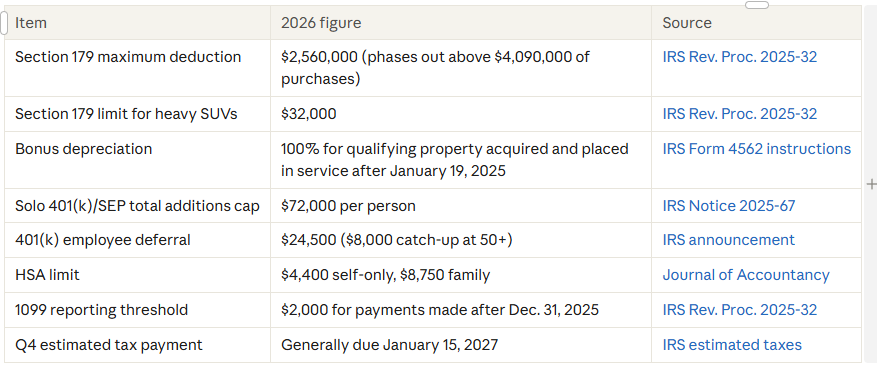
2026 numbers at a glance
The year-end tax planning checklist
Project your 2026 income and check your estimated payments. Run a rough profit-and-loss through today and annualize it. Most taxpayers avoid an underpayment penalty if they owe less than $1,000 after withholding and credits, or if they paid at least 90% of this year's tax or 100% of last year's, whichever is smaller, per the IRS estimated taxes page. Higher-income taxpayers have special rules. The fourth-quarter payment is generally due January 15, 2027.
Decide whether to defer income or accelerate expenses. If you use the cash method, income counts when you receive it and expenses when you pay them. In a strong year, you might delay sending a December invoice or pay a bill before year-end. In a weak year, you might do the opposite. Generally, do this only for amounts that make business sense, and never at the cost of cash flow you need.
Place equipment in service before December 31. For 2026, the Section 179 limit is $2,560,000, and 100% bonus depreciation is available for qualifying property acquired and placed in service after January 19, 2025. The key phrase is placed in service: the asset must be ready and available for use, not just ordered or paid for. A delivery truck that arrives January 3 is a 2027 asset. Not sure which method fits? See [INTERNAL LINK: add Week 5 post URL, anchor: Section 179 vs. bonus depreciation].
Use the de minimis safe harbor for smaller purchases. Under IRS rules, businesses without an audited financial statement can generally expense items costing $2,500 or less per invoice or item, if they make the annual election on a timely filed return, per the IRS tangible property regulations page. Group your laptop, tools, and furniture purchases and confirm they qualify.
Fund a retirement plan. A SEP IRA or solo 401(k) can shelter a meaningful chunk of self-employment income. For 2026, total additions to a defined contribution plan cap at $72,000 per person, and the 401(k) employee deferral limit is $24,500, with an $8,000 catch-up at age 50 and over, per IRS Notice 2025-67 and the IRS announcement. Your real limit is tied to your net earnings, so it is usually lower. Contribution deadlines differ by plan type, and some require action before December 31, so decide early.
Top off your HSA if you qualify. If you are covered by a high-deductible health plan, the 2026 limit is $4,400 for self-only coverage and $8,750 for family coverage, with an extra $1,000 for those 55 and older, per the Journal of Accountancy.
Review owner pay and your entity structure. If you are an S corporation owner, confirm your pay is reasonable for the work you do and that your records support it. If you are an LLC owner paying heavy self-employment tax, ask whether an S election makes sense for 2027. See our blog post about entity structure.
Check your QBI deduction. Eligible pass-through owners can generally deduct up to 20% of qualified business income, subject to income limits, per the IRS QBI page. Your taxable income, business type, and wages all affect the result, so check where you land before year-end moves change your numbers.
Collect W-9s and prep your 1099s. Starting with payments made after December 31, 2025, the general reporting threshold for contractors and similar payments rose from $600 to $2,000, per IRS Rev. Proc. 2025-32. Ask every vendor for a Form W-9 now, and list who you paid and how much. Payment-app and card payments are generally reported by the processor on Form 1099-K instead.
Get your records current. Reconcile your accounts, categorize transactions, and gather mileage logs and receipts so your preparer is not guessing in March. Clean records make every item above easier to support, and they surface deductions you would otherwise miss. Need a hand with your return itself? Our tax preparation service covers small business returns, and our tax planning services cover the year-end strategy.
Frequently asked questions
What small business tax moves should I make before December 31?
Start with four: project your 2026 income and make sure estimated payments are on track, place any planned equipment in service by year-end, fund a retirement plan or HSA, and tidy up vendor and 1099 records. The best mix depends on your entity type and income, so run the numbers before you spend money just for a deduction.
Do I have to buy equipment before December 31 to deduct it for 2026?
Buying is not enough. Section 179 applies to qualifying property you place in service during the tax year, meaning it is ready and available for use in your business by December 31. For 2026, the Section 179 limit is $2,560,000, and 100% bonus depreciation generally applies to qualifying property acquired after January 19, 2025.
When is the fourth-quarter estimated tax payment for 2026 due?
The fourth-quarter 2026 estimated payment is generally due January 15, 2027. Most taxpayers avoid an underpayment penalty by owing less than $1,000 after withholding and credits, or by paying at least 90% of this year's tax or 100% of last year's tax, whichever is smaller. Higher-income taxpayers have special rules, so confirm your target.
How much can I contribute to a SEP IRA or solo 401(k) for 2026?
For 2026, total additions to a defined contribution plan such as a SEP IRA or solo 401(k) are capped at $72,000 per person, and the employee deferral limit for a 401(k) is $24,500, plus catch-up amounts if you qualify. Your actual limit depends on your net self-employment income and plan type, so it is usually lower.
Do I need to send 1099s to contractors I paid in 2026?
Generally, you must report payments of $2,000 or more made in 2026 to a contractor for services, up from the old $600 threshold. Collect a Form W-9 from each vendor now so you have a name, address, and taxpayer ID before the January filing rush. Payment thresholds and exceptions vary, so check each vendor.
Ready to plan?
Book your year-end tax planning session and we will run your 2026 numbers before December 31.
Written by Scott Vance, Enrolled Agent, Taxvanta. Scott helps military families, veterans, and small business owners plan and prepare their taxes.
This article is for general information and isn't tax advice for your specific situation. Tax rules change, so confirm details with a qualified tax professional before acting.
Taxvanta, 300 S. Main St, Suite 212, Holly Springs, NC 27540 · (910) 360-8041 · scott@taxvanta.com · www.taxvanta.com