
S-Corp vs. LLC: How Your Business Structure Affects Your 2026 Tax Bill
Last updated: October 15, 2026
Quick Answer: An LLC is a legal structure, not a tax class, so the real choice is how it's taxed. By default, an LLC owner pays 15.3% self-employment tax on profit. An S-corp election can cut that tax by applying payroll tax only to a reasonable salary, but it adds payroll, filing, and compliance costs.
If you're weighing S-corp vs LLC taxes 2026, the first thing to know is that you aren't really choosing between two business types. An LLC is created under state law. An S-corp is a tax election the IRS lets certain businesses make. Plenty of small business owners run an LLC that is taxed as an S-corp, so the question that matters is how your profit gets taxed.
This guide compares the two side by side, walks through a $100,000 example, and explains when an S-corp election tends to be worth a closer look.
LLC vs. S-Corp: What's the Difference?
An LLC (limited liability company) protects your personal assets from business debts under state law. It doesn't come with one fixed federal tax treatment. According to the IRS, a single-member LLC is by default treated as a disregarded entity, so its income lands on your personal return (usually Schedule C). A multi-member LLC is by default a partnership, files Form 1065, and each owner receives a Schedule K-1. Members generally pay self-employment tax on their share of earnings.
An LLC can instead elect to be taxed as a corporation using Form 8832, or elect S-corp status using Form 2553. An LLC taxed as an S-corp files Form 1120-S, and the owners report their share of profit on a K-1.
S-Corp vs LLC Taxes 2026: Side-by-Side Comparison
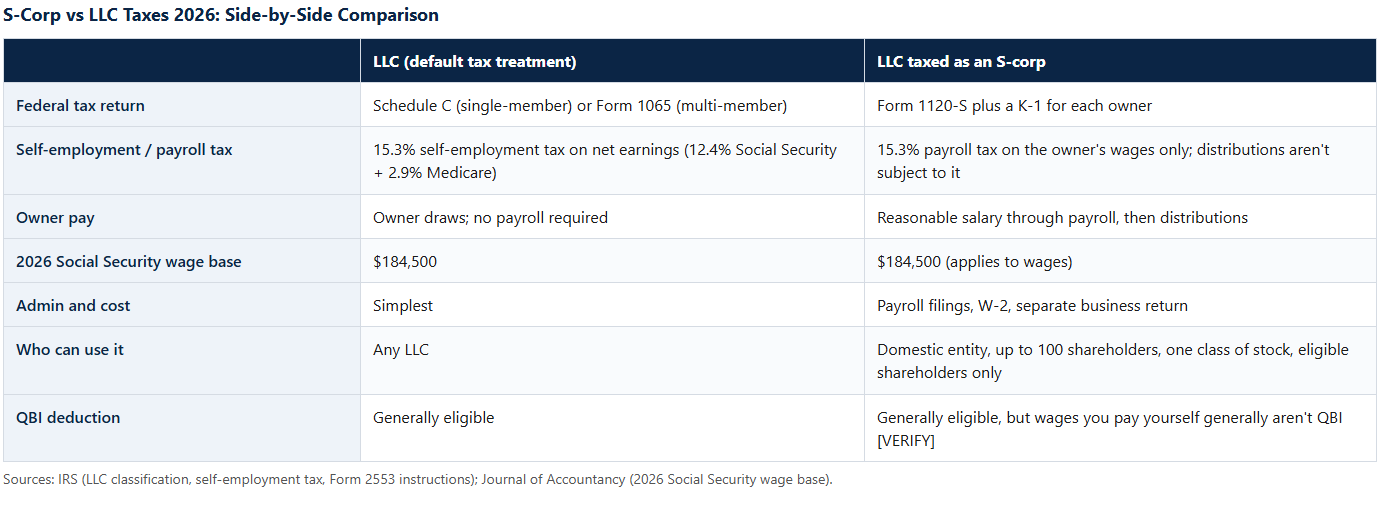
Side by side comparison of LLC versus and LLC taxed as an S-corp.
Sources for the table: the IRS self-employment tax page, the IRS Form 2553 instructions, and the Journal of Accountancy report on the 2026 Social Security wage base.
LLC vs S-Corp Self-Employment Tax: A $100,000 Example
Self-employment tax is the Social Security and Medicare tax you pay on your own business income. The IRS says the rate is 15.3%, and that generally the amount subject to the tax is 92.35% of your net earnings from self-employment. With an S-corp, you're an employee of your own company, so Social Security and Medicare tax applies to your salary instead.
Here's an illustration. Say your business nets $100,000 and, in this example, a reasonable salary for your work is $60,000. (That $60,000 is an assumption for the math, not a rule of thumb.)
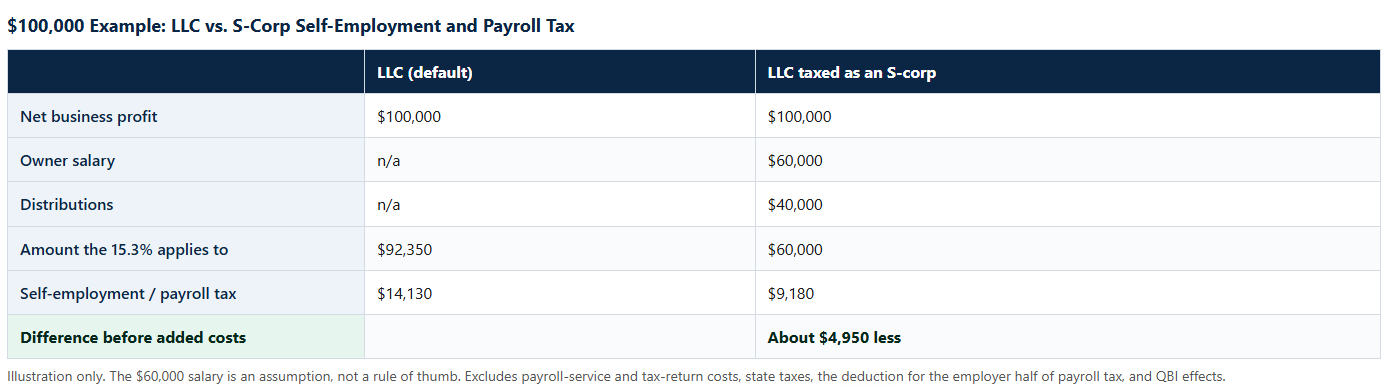
That gap is not pure savings. You'd pay for payroll processing and a separate business tax return, and state rules vary. The employer half of payroll tax also changes how much profit passes through, and the salary isn't part of your QBI. The example also stays under the 2026 Social Security wage base of $184,500, so the full 15.3% applies. Your numbers will differ.
Should I Elect S-Corp Status?
An S-corp election is generally worth a serious look when your net profit is steady and comfortably above what you'd reasonably pay yourself for the work you do. It's often a poor fit when:
profit is low, uneven, or still ramping up, because the added costs can outweigh the tax difference
the business had a loss, since there's little payroll tax to shift
you want the simplest bookkeeping and filing setup possible
you need more than one class of ownership or have shareholders who aren't eligible
If you're also planning equipment purchases this year, the entity question can interact with your depreciation plan; see our Section 179 vs. bonus depreciation guide. Our tax planning services include running both scenarios with your actual numbers.
What Is "Reasonable Compensation" for an S-Corp Owner?
This is the rule that keeps the election honest. The IRS says S corporations must pay reasonable compensation to a shareholder-employee before making non-wage distributions, and that wages are subject to employment taxes while non-wage distributions are not. The IRS can recharacterize payments as wages if the pay is too low.
Factors the IRS lists include your training and experience, duties and responsibilities, time and effort devoted to the business, what comparable businesses pay for similar services, and payments to non-shareholder employees. A good practice is to document how you landed on your salary each year.
How the S-Corp Election Works and When to File
For an eligible LLC, the election is made on Form 2553. Per the IRS instructions, it's generally due no more than 2 months and 15 days after the start of the tax year the election takes effect, or at any time during the preceding tax year. For a calendar-year business, that's March 15. Because the election can be filed during the year before it takes effect, a fall conversation about your 2027 structure can be timely.
If you missed the deadline, late-election relief under Rev. Proc. 2013-30 may be available when you show reasonable cause and act diligently; the IRS instructions say relief generally must be requested within 3 years and 75 days of the effective date on the form.
What About the QBI Deduction?
The qualified business income (QBI) deduction lets many owners of pass-through businesses deduct up to 20% of their qualified business income, subject to limits. The 2025 tax law (OBBBA) made the 20% deduction permanent. Salary paid to an S-corp owner generally reduces the profit that counts as QBI, so the entity decision and the QBI deduction should be modeled together.
Frequently Asked Questions
Should I elect S-corp status for my LLC?
It depends on profit and costs. An S-corp election can lower self-employment-type taxes when your net profit is well above a reasonable salary for your work, because only wages carry payroll tax. It also adds payroll, a separate business return, and stricter rules. Many owners with low or uneven profit are better off staying with the default LLC tax treatment.
How does LLC vs S-corp self-employment tax differ?
A single-member LLC owner generally pays 15.3% self-employment tax on net earnings from the business. With an S-corp election, you pay yourself a salary that carries the same 15.3% in payroll taxes, but remaining profit passed through as distributions is not subject to that tax. Income tax still applies to all profit.
What is reasonable compensation for an S-corp owner?
Reasonable compensation is the pay a business would give someone for the same services. The IRS looks at your training, duties, time spent, what comparable businesses pay, and payments to other employees. If you take distributions without paying yourself reasonable wages, the IRS can reclassify those payments as wages and assess employment taxes.
When is the deadline to make an S-corp election?
Form 2553 is generally due no more than 2 months and 15 days after the start of the tax year the election takes effect, or at any time during the prior tax year. For a calendar-year business, that means March 15. Late-election relief may be available if you show reasonable cause, so ask a tax professional before assuming you missed your chance.
Next Step
Find out if an S-corp election makes sense for you. If you're also comparing preparers, see how to choose a tax preparer for your small business.
Written by Scott Vance, Enrolled Agent, Taxvanta. Scott helps military families and small business owners plan ahead and file with confidence.
This article is for general information and isn't tax advice for your specific situation. Tax rules change, so confirm details with a qualified tax professional before acting.
Taxvanta, 300 S. Main St, Suite 212, Holly Springs, NC 27540 | (910) 360-8041 | scott@taxvanta.com | www.taxvanta.com