
Last updated: October 22, 2026
Quick Answer: Owning a veteran-owned business doesn't by itself earn a federal tax credit. The credits that matter depend on what you do: the Work Opportunity Tax Credit (WOTC) for hiring certain veterans, which has lapsed for 2026 hires unless Congress renews it, and the credit for paying employees who are away on military duty.
If you served and then started a business, you may have heard that there are veteran owned small business tax credits waiting for you. The truth is more specific. Most of the money comes from what your business does (hiring, payroll, benefits), not from the fact that a veteran owns it. This guide walks through five things veteran business owners ask about most, what each one really does, and where 2026 has changed the picture.
Does being veteran-owned earn a tax credit?
No. There is no federal credit that applies simply because a veteran owns the business. Veteran status helps in other ways, such as federal contracting set-asides and, for the people you hire, certain hiring credits. Your return still comes down to the same basics as any other small business: income, ordinary deductions, and the credits your activity qualifies for.
5 veteran-owned business credits and benefits to know for 2026
Work Opportunity Tax Credit (WOTC) for hiring veterans. Eligibility: you hire a veteran in a qualifying category (see the table below) and file the paperwork on time. The 2026 catch: the IRS describes the credit as available for people who begin work on or before December 31, 2025, and as of this writing we haven't confirmed that Congress has renewed it. [VERIFY before publishing] Veterans who started by that date still count for wages you pay them. For 2026 hires, many employers keep screening and filing anyway, because Congress has restored the credit retroactively before. Treat any 2026 WOTC as possible, not promised.
Employer differential wage payment credit. Eligibility: you keep paying an employee, in whole or in part, while they are on active duty for more than 30 days, for example a reservist or National Guard member who has worked for you at least 91 days. The credit is 20% of the differential pay (the difference between their military pay and their normal pay), on up to $20,000 per employee per year, so up to $4,000 per employee. It is claimed on Form 8932, and as far as we can tell it has no sunset date.
Retirement plan startup credit. Eligibility: a small employer that sets up a new 401(k), SIMPLE, or similar plan. This isn't veteran-specific, but veteran owners who are hiring often add a plan to compete for talent. It is claimed on Form 8881. Credit percentages and caps depend on your employee count and the year, so we confirm the numbers for your situation before you commit. [VERIFY amounts]
VOSB and SDVOSB certification (not a tax credit). Eligibility: at least 51% owned by veterans (or service-disabled veterans for SDVOSB), registered on SAM.gov, and within SBA size standards. Certification runs through the SBA's VetCert program and is mainly for bidding on federal set-aside contracts. It can win you work, but it doesn't reduce your tax bill directly.
State veteran incentives. Eligibility: varies by state. Some states offer their own hiring credits or property and licensing breaks for veteran-owned businesses, and details change often. Check your state's revenue or veterans affairs department, or ask us, before assuming a benefit exists or doesn't.
WOTC for veterans: who qualifies and how much
The IRS lists five qualified-veteran categories. The credit is a percentage of first-year wages, up to a cap: generally 40% for an employee who works at least 400 hours, and 25% for 120 to 399 hours. The maximum amounts below are for 400+ hours, as summarized by the SBA.
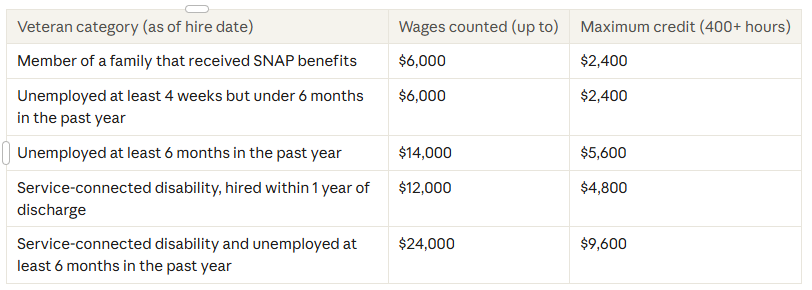
The process matters as much as the eligibility. File IRS Form 8850 with your state workforce agency within 28 days of the employee's first day of work, then claim the credit on Form 5884 with your return. Missing the 28-day window is the most common way employers lose the credit.
How to put this to work
A practical order of operations for a veteran-owned small business: screen every new hire for WOTC categories during onboarding, keep Form 8850 deadlines on your calendar even while the credit is in limbo, document differential pay for any employee called to duty, and talk to your tax professional about retirement plan timing before year-end. If you're also weighing structure, see our guide on S-Corp vs. LLC taxes.
Frequently asked questions
What is the WOTC veteran hiring credit?
The Work Opportunity Tax Credit rewards employers for hiring people from targeted groups, including certain veterans. For a qualified veteran working at least 400 hours, the credit is generally 40% of first-year wages up to a cap, worth $2,400 to $9,600 depending on the veteran's category. You must file Form 8850 within 28 days of the start date.
Are there tax benefits for veteran-owned businesses?
There is no federal tax credit just for being veteran-owned. Veteran owners can still benefit from credits tied to what the business does, such as hiring qualified veterans, paying employees on military leave, or starting a retirement plan. Ordinary deductions apply too. Some states add their own veteran incentives, so check your state's rules.
Does VOSB certification give you tax advantages?
Not directly. VOSB and SDVOSB certification through the SBA's VetCert program is mainly for competing for federal contracts set aside for veteran-owned firms. It doesn't create a federal tax credit or deduction. Certification can help you win work, and that income is taxed like any other business income.
Can I claim WOTC for veterans I hire in 2026?
As of October 22, 2026, the credit's authorization ended for people who start work after December 31, 2025, and we haven't seen confirmation that Congress renewed it. Past lapses were often restored retroactively, so many employers keep screening hires and filing Form 8850 on time. Confirm the current status with your tax professional before counting on it.
Next step
See which veteran business credits you qualify for. Our tax planning and tax preparation services help military and veteran business owners plan before the year closes.
Written by Scott Vance, Enrolled Agent, Taxvanta. Scott helps military families and small business owners keep more of what they earn through year-round tax planning and accurate tax preparation.
This article is for general information and isn't tax advice for your specific situation. Tax rules change, so confirm details with a qualified tax professional before acting.
Taxvanta, 300 S. Main St, Suite 212, Holly Springs, NC 27540 | (910) 360-8041 | scott@taxvanta.com | www.taxvanta.com